Donald Trump promised not to pull any punches in his fight with the deep state.
Trump is making good on that pledge.
And Donald Trump pulled off this surprise that is doomsday for the deep state.
As West Wing Daily reports:
Traditionally, the people who are chosen to lead the intelligence agencies in the U.S. are people who believe very deeply in surveillance and the spy programs that those agencies engage in.
Having someone who is a skeptic of government spying in charge of those agencies would be an unprecedented thing in American history that would send shockwaves through the government.
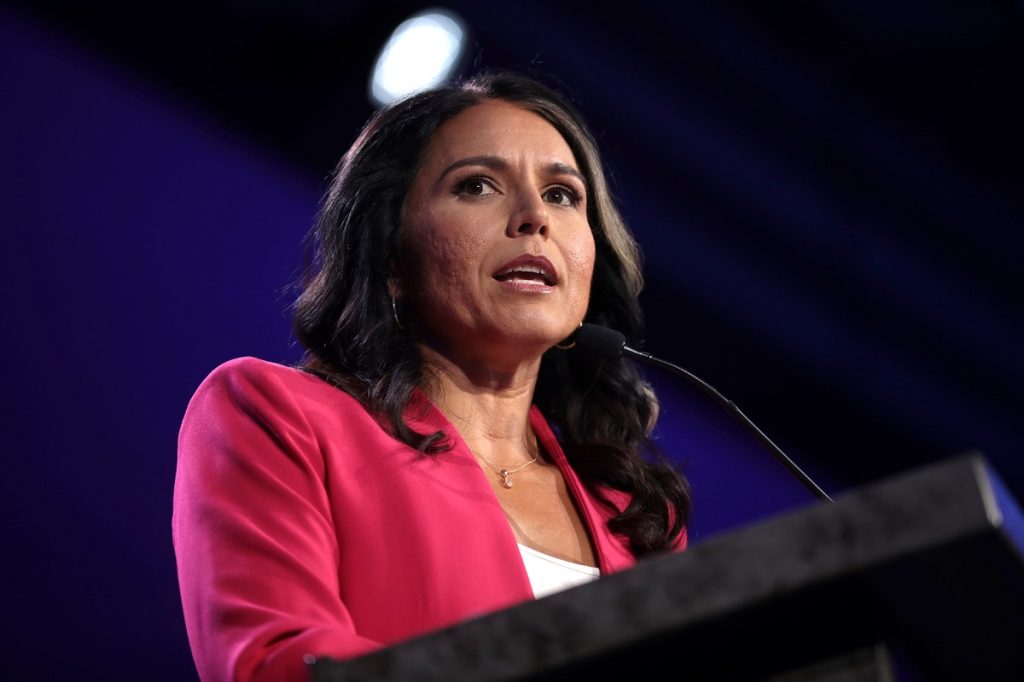
That may soon be the case, however, as Donald Trump has chosen former Hawaii Rep. Tulsi Gabbard as the new director of National Intelligence.
Gabbard is a longtime opponent of the so-called “Patriot Act” and has expressed major skepticism of any form of government surveillance.
Because of that, there will be a lot of controversy during her confirmation proceedings, as many senators from both parties are staunch supporters of the spy programs and the intelligence community.
But Trump is not backing off on his selection of Gabbard, and Gabbard so far has not compromised her principles when it comes to surveillance.
According to The Economist, “Of Donald Trump’s nominees to high office, few are more suspicious of the government they are pegged to join than Tulsi Gabbard. She warns of a ‘slow-rolling coup’ by ‘the entire permanent Washington machine,’ as she describes it in ‘For Love of Country,’ a campaign book published in April. Her list of putschists is long, catholic and spook-heavy: ‘the Democratic National Committee, propaganda media, Big Tech, the FBI, the CIA, and a whole network of rogue intelligence and law enforcement agents working at the highest levels of our government’. Yet she may soon oversee some of that machinery.”
Overseeing this “machinery” will give Gabbard the opportunity to reform it, which is the last thing that many people who work for these agencies want.
That’s why they are so worried about Gabbard taking over and are trying to do whatever they can to stop it.
The article continues, “The Economist spoke to a dozen former and serving intelligence officials from America and European allies to ask them how they thought all this churn might affect American and allied agencies. Some urged calm. One American official said that he had briefed Ms. Gabbard on the House Armed Services Committee and that she was less radical in private than in public.”
Gabbard’s views, or at least the ones she has publicly stated, are not exactly “radical” in the way most Americans would understand the term.
She is not arguing for all surveillance to be ended, just the surveillance directed at American citizens.
Spying on hostile foreign countries will almost certainly continue while she is the director of National Intelligence.
But American citizens will presumably no longer be targeted by these agencies that are supposed to be focused on national security, not domestic issues.
That is a change that millions of Americans will welcome after the proliferation of spying that has taken place since 9/11.